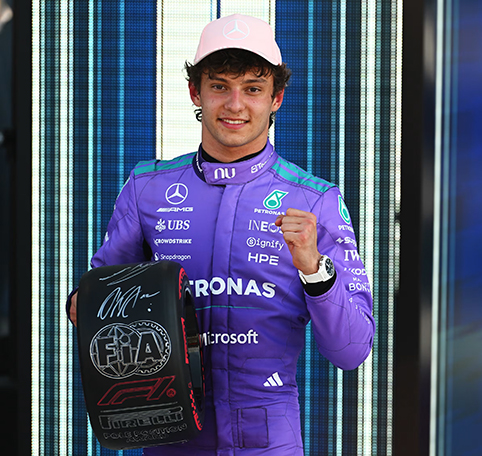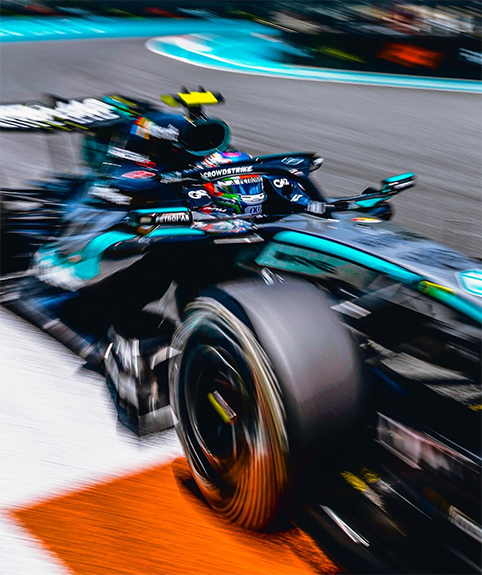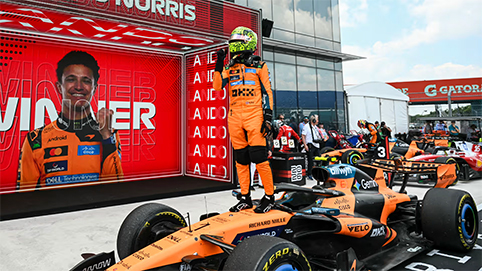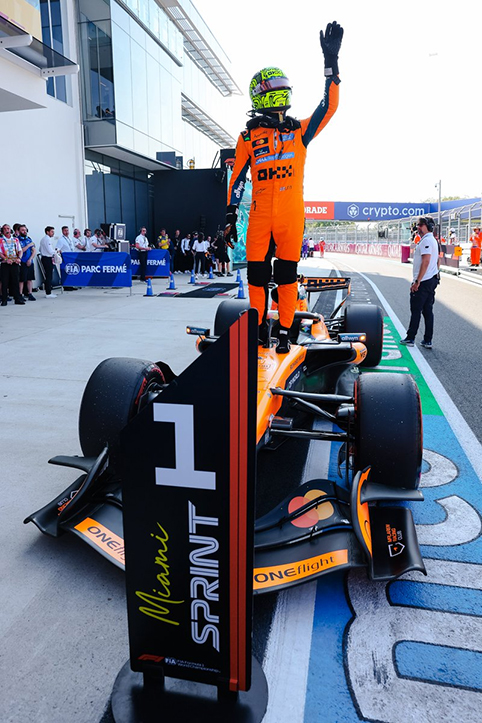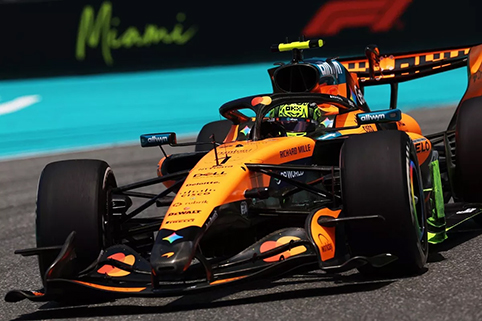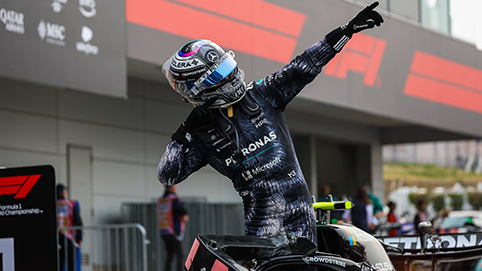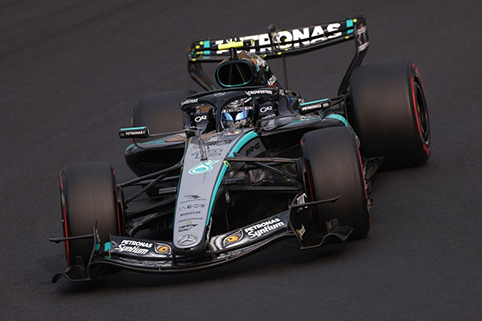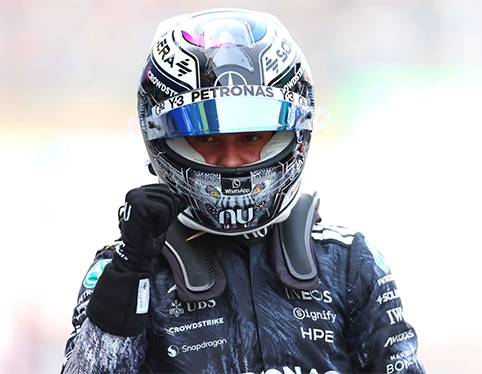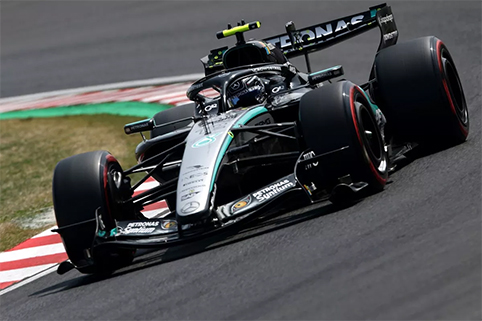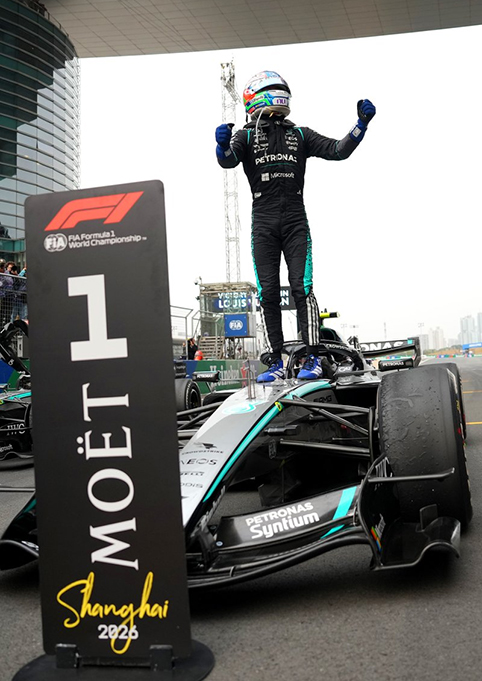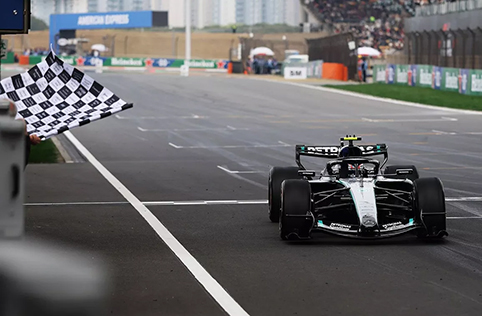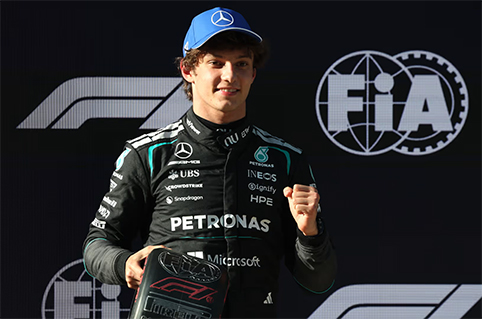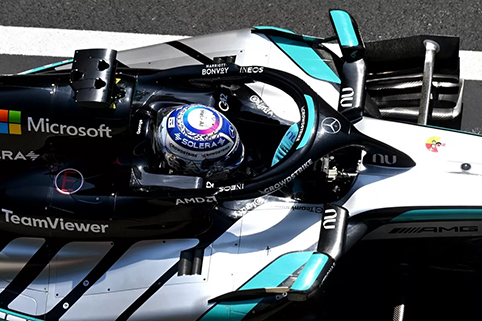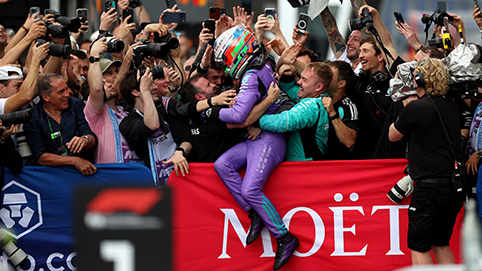
That was a wild and entertaining Miami Grand Prix and yet Andrea Kimi Antonelli came out on top to achieve his third consecutive Formula 1 victory for Mercedes.
The Mercedes driver underlined his title ambitions by winning and resisting the pressure from reigning world champion Lando Norris.
Antonelli held off Norris after a dry race at the Miami International Autodrome, with Oscar Piastri completing the podium for McLaren after a late-race fade by Charles Leclerc, who had a spin on the final lap, allowing George Russell into fourth and Max Verstappen to take sixth.
The race started three hours earlier than planned as organisers tried to find a window to get the 57-lap race due to the constant threat of rain and thunderstorms.
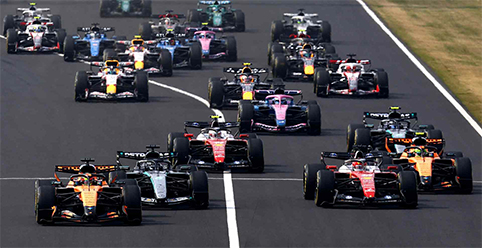
But despite the prospect of rain, the race started in dry conditions, with the majority of the field setting off on medium tyres. At a chaotic start, polesitter Antonelli suffered another poor getaway, allowing Red Bull’s Verstappen and Ferrari’s Leclerc to immediately draw alongside as they went towards Turn 1.
Antonelli locked up and went off, while Leclerc took a cautious line into the corner that ended him the lead. Behind him Verstappen spun off on the exit, with the Red Bull rapidly pointing his car in the right direction again. In doing so, Verstappen was lucky not to be collected by the chasing pack, but he did drop down to P10 battling the Williams drivers.
That allowed McLaren duo Norris and Piastri through to claim third and fourth, ahead of Russell and Hamilton, with the latter surviving contact with Alpine’s Franco Colapinto.
On lap 4 Antonelli passed Leclerc for the lead, with Leclerc returning the favour on the following lap while Norris also followed the Ferrari driver through into second.
The race was neutralised after just five laps due to two separate incidents. In a spectacular-looking accident, Alpine’s Pierre Gasly was flipped into a low-speed barrel roll after being clipped by Racing Bulls driver Liam Lawson at Turn 17, Gasly ending up halfway up the barrier but escaping unhurt. Lawson also retired with terminal damage.
Meanwhile, Red Bull’s Isack Hadjar crashed at the chicane while working his way up the order, the Red Bull driver having been demoted to a pitlane start due to a technical issue. Making an unforced error, Hadjar tagged the inside wall at Turn 14 which sheared off the front-left suspension and sent his car into the barriers at low speed.
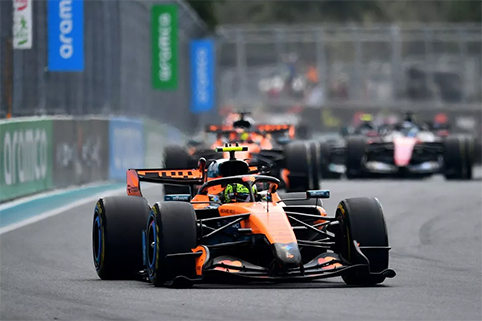
After the lap 12 restart Norris snatched the lead away from Leclerc ahead of Antonelli, followed by a duelling Piastri and Russell. Verstappen had been the only frontrunner to pit for hards under the safety car, which initially dropped him down to P16. But as the expected rain did not materialise and the frontrunners also picked up hard tyres around the halfway point, Verstappen emerged into a lead and yet it was short-lived.
On much fresher tyres, Antonelli and Norris were both quickly able to repass Verstappen as he lost touch with the leaders, while Leclerc was fourth as Piastri passed Russell for fifth. Hamilton lost out after a slower pitstop, which demoted him to seventh and last of the frontrunners, while the Ferrari driver also appeared to nurse a damaged Ferrari after his early contact with Colapinto.
With no rain forthcoming, the race turned into a straight-forward one-stopper, and a duel between Antonelli and Norris as Verstappen struggled to keep up. On balance, Norris looked the quicker of the two but was unable to find a way past in Antonelli’s dirty air/.
But Antonelli managed to survive downshift issues and hang on to take his third consecutive win from pole, expanding his world championship lead on Russel to 24 points.
On worn Pirelli rubber Verstappen fell into the chasing group of Leclerc, Piastri and Russell in the final ten laps of the race. True to form Verstappen did not go down without a fight, clinging on to third around the outside of Leclerc, but he was powerless to hold off the Ferrari for much longer, and both Piastri and Russell also worked their way past.
Leclerc looked destined to take the final podium spot, but spun on the final lap, tapping the wall but luckily avoiding harder contact. Piastri went through to take third 27 seconds behind Antonelli, while Russell muscled his way to fourth ahead of Verstappen and Leclerc.
Hamilton finished a lonely seventh, with Colapinto eighth after a strong weekend performance, the Argentine running as high as fourth after delaying his first stop until lap 32.
In the background Carlos Sainz and Alex Albon defeated the Haas drivers to take an encouraging double points finish in ninth and tenth for the underperforming Williams outfit, being the last two cars finishing on the lead lap.
So a thrilling race in Miami with Antonelli taking victory. Kimi is riding this winning form with so much confidence and has the performance edge over his Mercedes teammate Russell. The next race will be Canada, in which last year George won. He needs to do the same to reduce the points gap.
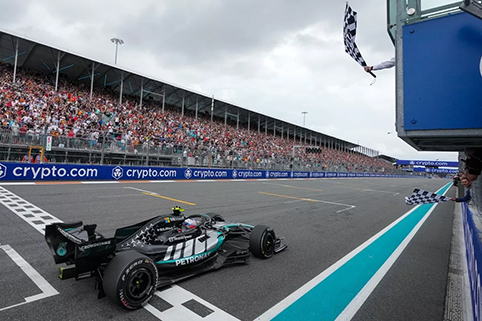
Miami Grand Prix, race results:
1 Andrea Kimi Antonelli Mercedes 1:33:19.273
2 Lando Norris McLaren-Mercedes +3.264s
3 Oscar Piastri McLaren-Mercedes +23.828s
4 George Russell Mercedes +43.051s
5 Max Verstappen Red Bull-Ford +43.949s
6 Charles Leclerc Ferrari +44.245s
7 Lewis Hamilton Ferrari +53.753s
8 Franco Colapinto Alpine-Mercedes +61.871s
9 Carlos Sainz Williams-Mercedes +82.072s
10 Alexander Albon Williams-Mercedes +90.972s
11 Oliver Bearman Haas-Ferrari +1 lap
12 Gabriel Bortoleto Audi +1 lap
13 Esteban Ocon Haas-Ferrari +1 lap
14 Arvid Lindblad Racing Bulls-Ford +1 lap
15 Fernando Alonso Aston Martin-Honda +1 lap
16 Sergio Perez Cadillac-Ferrari +1 lap
17 Lance Stroll Aston Martin-Honda +1 lap
18 Valtteri Bottas Cadillac-Ferrari +2 laps
Nico Hulkenberg Audi DNF
Liam Lawson Racing Bulls-Ford DNF
Pierre Gasly Alpine-Mercedes DNF
Isack Hadjar Red Bull-Ford DNF