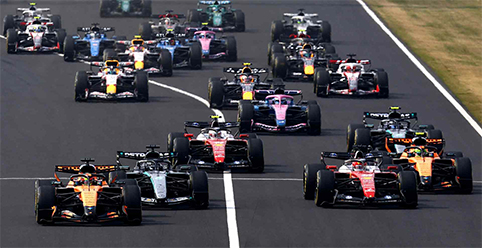
The sport’s governing body, the teams and manufacturers have all agreed on adjustments to the 2026 Formula 1 regulations. The changes mainly concern energy management, with the aim of making qualifying more on the limit and increasing safety.
After two discussions with technical chiefs, the most recent meeting was significant in terms of progress especially on the agenda on how the technical regulations could be improved based on the opening three rounds, and ahead of the Miami Grand Prix.
Both the FIA and Formula 1 had made it clear beforehand that major changes were highly unlikely, also because both the governing body and the commercial rights-holder do not consider the racing itself to be issue – despite some complaints about “yo-yo” racing.
The two topics that are highlighted in a statement shared by the FIA after the meeting: qualifying needs to be more on the limit again, and safety must be improved, especially after the closing speeds played a major role in Oliver Bearman’s crash in Japan, Suzuka.
The proposals agreed are as follows and will be implemented from Miami apart from the race start changes that will be tested in Miami and adopted following feedback and analysis.
Qualifying – promoting performance
Adjustments to energy management parameters, including a reduction in maximum permitted recharge from 8MJ to 7MJ, aimed at reducing excessive harvesting and encouraging more consistent flat-out driving. This change targets a maximum superclip duration reduced to approximately 2-4 seconds per lap.
Peak superclip power increased to 350 kW, previously being 250kW, further reducing the time spent recharging, and reducing driver workload on energy management. This will also be applied in Race conditions.
The number of events where alternative lower energy limits may apply has been increased from 8 to 12 races, allowing greater adaptation to circuit characteristics.
Race – improved safety and consistency of performance
The maximum power available through the Boost in race conditions is now capped at +150 kW (or the car’s current power level at activation if higher) limiting sudden performance differentials.
MGU-K deployment is maintained at 350 kW in key acceleration zones (from corner exit to braking point, including overtaking zones) but will be limited to 250 kW in other parts of the lap.
These measures are designed to reduce excessive closing speeds while maintaining overtaking opportunities and overall performance characteristics.
Race starts – enhanced safety mechanisms
A new “low power start detection” system has been developed, capable of identifying cars with abnormally low acceleration shortly after clutch release.
In such cases, an automatic MGU-K deployment will be triggered to ensure a minimum level of acceleration and mitigate start-related risks without introducing any sporting advantage.
An associated visual warning system is being introduced, activating flashing lights (rear and lateral) on affected cars to alert following drivers.
A reset of the energy counter at the start of the formation lap has also been implemented to correct a previously identified system inconsistency.
Wet conditions – improving safety and visibility
Tyre blanket temperatures for intermediate tyres have been increased following driver feedback in order to improve initial grip and tyre performance in wet conditions.
Maximum ERS deployment will be reduced, limiting torque and improving car control in low-grip conditions.
The rear light systems have been simplified, with clearer and more consistent visual cues to improve visibility and reaction time for following drivers in poor conditions.
This is a step in the right direction and hopefully these tweaks will improve the spectacle in particular in qualifying, where the sense of speed or drivers pushing the limit is back as in not the case in the first three sessions of the year – in which it was lift and coast…
In addition to the energy management, safety is still an important factor in this new regulations.
Official statement:
https://www.fia.com/news/refinements-2026-fia-formula-1-regulations-agreed-all-stakeholders
https://www.formula1.com/en/latest/article/refinements-to-2026-f1-regulations-agreed-by-all-stakeholders.1xA0TRau0DvyId6R7oZjFv
News stories:
https://www.racefans.net/2026/04/20/fia-confirms-planned-changes-to-f1-rules-after-crunch-meeting/
https://www.motorsport.com/f1/news/fia-confirms-2026-f1-rule-changes-ahead-of-miami-grand-prix/10814169/
https://www.autosport.com/f1/news/are-f1s-technical-changes-for-miami-enough-to-ease-2026-concerns/10814180/
https://www.bbc.co.uk/sport/formula1/articles/cp84xd25wg9o
https://www.the-race.com/formula-1/f1-2026-mid-season-rule-changes/
https://www.the-race.com/formula-1/the-reality-of-f1s-boring-2026-rules-changes/
https://www.skysports.com/f1/news/12433/13534141/f1-rule-changes-confirmed-for-miami-gp-with-aim-of-producing-more-flat-out-driving-and-improving-safety
Formula 1 bosses will use “a scalpel rather than a baseball bat” in making changes to the sport’s rules at a meeting on Monday (April 20), says Mercedes team principal Toto Wolff.
The team bosses are meeting with commercial rights holder F1 and governing body the FIA to discuss changes to the power-unit regulations in the light of criticism of new rules from drivers.
Red Bull’s Max Verstappen said at the last race in Japan that he was considering his future in F1 because of his lack of satisfaction with the new cars.
Wolff said on Monday: “The discussions that have been taking place between the group of drivers, the FIA, Formula 1, and the teams have been constructive. And we all share the same objectives.
“It’s how can we improve the product, make it out-and-out racing, and look at what can improve in terms of safety, but act with a scalpel and not with a baseball bat.
“So I think we are coming to good solutions that we are going to ratify hopefully today, in order to evolve, because it’s only three races in.”
Mercedes driver George Russell said last week that the drivers had fed into discussions with the FIA and “had two headline points – flat-out qualifying, so no lift and coast, and then reducing the closing speeds”.
Verstappen’s concerns centre on the new power-units introduced this year, and the degree of energy management required.
The engines have a near 50-50 split between internal combustion and electrical power. This, as well as a series of complex regulatory constraints, has introduced a new form of driving and racing.
Verstappen does not enjoy either of the two main changes – qualifying laps are no longer on the limit at all times, in the traditional sense, because of the need to recharge the battery; and racing is being affected by the large variations in battery charge level and the new “overtaking” and “boost” modes – all of which leads to huge speed differentials between cars.
Wolff said: “I am carefully optimistic that we’re going to improve the racing, while keeping the racing really good.
“If you have aligned objectives, and you define those objectives at the beginning, and that is, how can we work on making qualifying more spectacular, enjoyable for the drivers? How can we tackle safety objectives? And at the same time, protect what’s really good within the racing, the overtaking. And that’s why those steps look like they are in the right direction.
“Not overshooting, not undershooting, but if you come to the conclusion further down the line, that we need to maybe redefine the objectives, then so be it. But at the moment, I think that’s carved out in a pretty clear way, and that’s good.”
https://www.bbc.co.uk/sport/formula1/articles/c75kg9vrd3xo